
Learning in a multimodal environment
To keep education in line with rapid changes at the global level, it is necessary to adapt classes, forms and methods of teaching and learning according to modern pedagogy. Changes in teaching, learning and communication are correlated with social, technological, economic, and cultural changes. Modern pedagogy promotes a lifelong learning approach, emphasizing that every learning activity should involve active participation (Drew, Mackie, 2011). Active learning involves individuals taking responsibility for their own learning, actively participating in the process, and collaborating with teachers to explore and construct knowledge. To enhance the effectiveness of this learning approach, it is highly recommended to learn in a multimodal learning environment. The term multimodal implies the creation of meaning and the expression of opinions with the help of a combination of words, images, sounds and symbols. In the pedagogical context, learning in a multimodal environment presupposes modern teaching that aims to keep the individual mentally and physically active throughout the learning process (Jewitt, 2013). The aforementioned is achieved through various activities that encourage and develop cognitive and developmental processes of the learning individual.
A multimodal environment in education promotes active engagement of learners both mentally and physically during the learning process, combining words, images, sounds, and symbols to create meaning and express opinions (Jewitt, 2013). This is accomplished through diverse activities that promote cognitive and developmental processes of learners. Modern pedagogy promotes active and collaborative learning through various teaching methods like research, problem-based learning and project-based learning (Drew, Mackie, 2011; Falk, 2008). To ensure the effectiveness of active learning, it is important to develop a multimodal learning environment and foster interactivity through collaborative learning, diverse content presentations and simulations, models, animations and real-life experiences (Cook-Sather, Matthews, 2021; Jewitt, 2013; Moreno, Mayer, 2007).
Digital technology plays a significant role in fostering a multimodal learning environment by offering dynamic and engaging experiences that align with student interests (Falk, 2008; Moreno, Mayer, 2007). In such an environment, learning occurs based on the learner’s activities and actions, with the teacher mentoring and guiding the learners. Peer collaboration, self-regulated learning, and co-creation are encouraged in a multimodal environment, which also corresponds to different learning styles (Moreno, Mayer, 2007; Ridwan et al., 2019). Learning styles are unique to individuals and reflect their preferred learning strategies. Each learner possesses distinct preferences when it comes to processing and retaining information. Fleming’s VARK model is a commonly used learning model that classifies learners into four areas based on their sensory preferences: visual, auditory, reading and kinesthetics learning style (Falk, 2008; Ridwan et al., 2019).
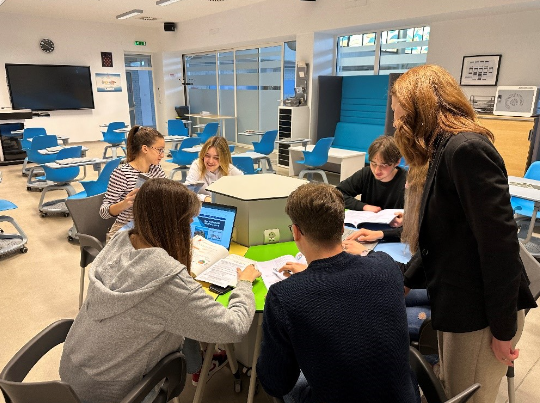
Source: High school Ivanec
A multimodal learning environment enhanced with digital technology empowers learners, regardless of their learning style, to achieve better learning outcomes in an innovative and creative manner through play and research. Incorporating modern teaching technology and digital educational content in the learning process fosters students’ creativity, increases their motivation to learn, facilitates the creation of new knowledge and ultimately leads to better learning success (Drew, Mackie, 2011; Falk, 2008; Jewitt, 2013; Michael, 2006). By adopting collaborative learning methods, experiential learning, and project-based approaches, students are prepared for lifelong learning and critical thinking. These teaching methods are particularly effective when students need to grasp complex concepts or tackle tasks at higher cognitive levels, especially in the STEM field (Jewitt, 2013; Parbuntari, Ikhsan, 2014). Learning in a multimodal environment encourages co-creation in education, with digital exhibitions being a modern tool that facilitates such learning experiences.
Literature:
Cook-Sather, A., Matthews, K. E., (2021). Pedagogical partnership: engaging with students as co-creators of curriculum, assessment, and knowledge. In (eds.) University Teaching in Focus: A learning-centred approach. Routledge, 243-259.
Drew, V., Mackie, L. (2011). Extending the constructs of active learning: implications for teachers´ pedagogy and practice, The Curriculum Journal, 22 (4): 451-467.
Falk, B. (2008). Teaching the way children learn. New York: Teachers College Press.
Jewitt, C. (2013). Multimodal methods for researching digital technologies. In: Price, S., Jewitt, C., Brown, B. (eds.) The SAGE Handbook of Digital Technology Research. Los Angeles: Sage.
Michael, J. (2006). Where`s the evidence that active learning works? Advances in Physiology Education, 30(4): 159-167.
Moreno, R., Mayer, R. (2007). Interactive Multimodal Learning Environments, Educational Psychology Review, 19(3): 309-326.
Parbuntari, H., Ikhsan, J. (2014). The use of hybrid multimodal learning on chemistry at senior high school to improve students’ motivation. Proceeding of International Conference On Research, Implementation And Education Of Mathematics And Sciences.
Ridwan, H., Sutresna I. and Haryeti P. (2019). Teaching styles of the teachers and learning styles of the students. Journal of Physics, 1-7.